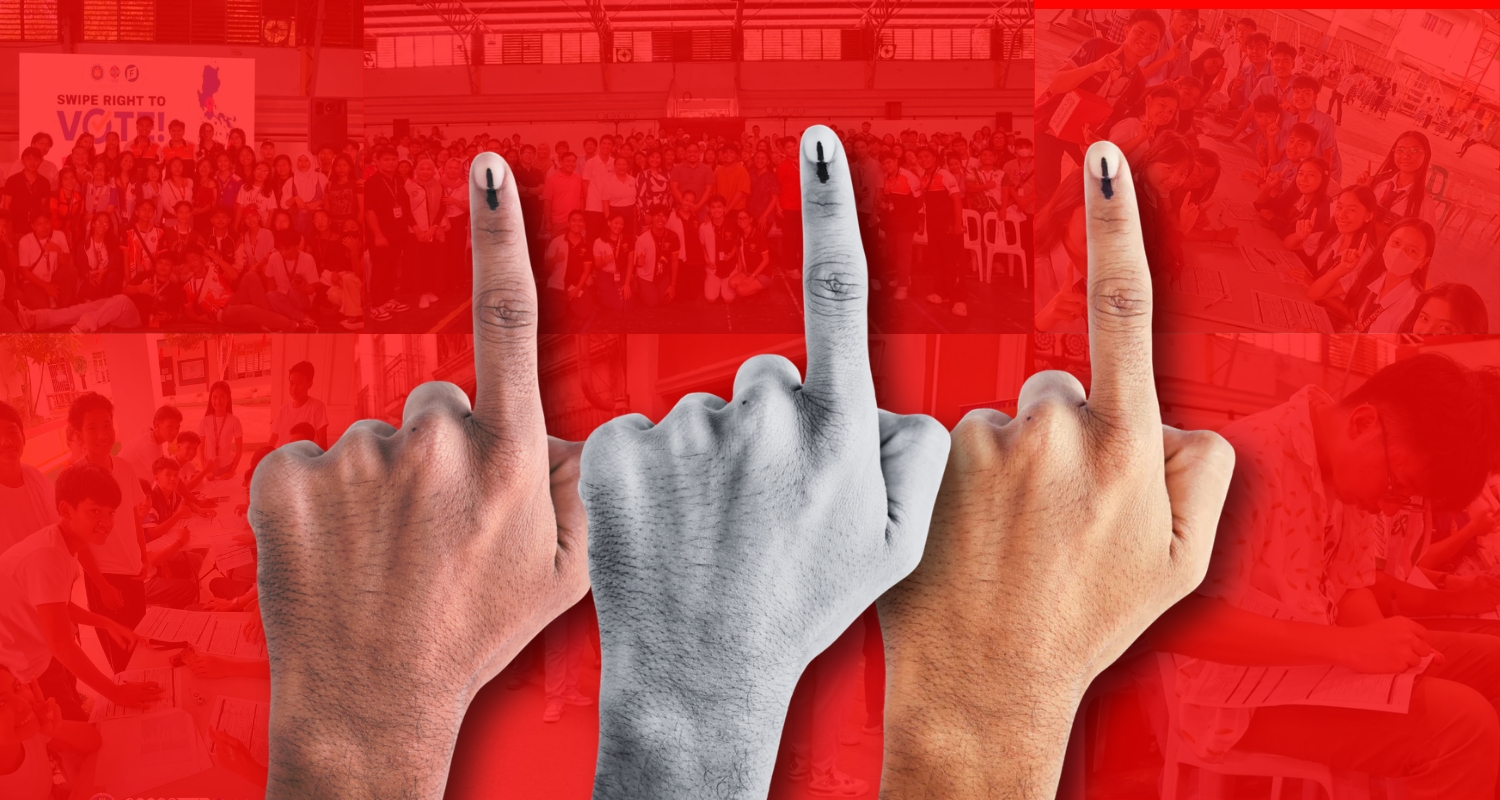
Featured art by Cine Inosanto.
For many years now, our country’s political climate is in the midst of a high-stakes tug-of-war between traditional leadership and the rising demand for transparency and systemic change. Granted how even the smallest edge has the power to determine the fate of an entire province, it just proves that the value of every single vote carries that weight of a thousand echoes.
For others, the belief that one vote doesn’t matter still persists and continues to invalidate the importance of the very action of voting. However, history also consistently proves that these collective “ones” are the reason and the foundation of a movement.
Even as the entire Philippines is in turmoil, the anticipation continues to build up for yet another crucial moment for the country’s democratic journey. As the time for the national and local election approaches, the weight of the most important step of all–Voter Registration–is becoming heavier than ever.
And just like everything in the world, the door to this opportunity is never permanent. As a Filipino Citizen, to participate in both the registration and the actual election are one of the most fundamental ways we can exercise our rights to decide and shape the future of our community and on a bigger scale. our country. It is our moment to turn our voices, beliefs, and hopes into measurable actions.
The current voter registration period for the upcoming 2026 Barangay and Sangguniang Kabataan (SK) elections is ending soon. According to the Commission on Elections (COMELEC), the registration will officially end on May 18, 2026.
For the remaining days, however, the registration is open from Mondays to Saturdays at your local Office of Election Officer (OEO). To miss out on this opportunity is to sit out of a crucial decision-making process for your community and country and bear the burden of its consequences.
Who can (and should) register?
In order to qualify for the registration, you must, first of all, be a Filipino citizen and at least 18 years of age on or before the day of the election. For the SK elections specifically, youth with ages 15 to 30 years old are eligible to register and vote for their local youth representatives. Being a resident of the Philippines for at least one year and a resident of the place where you intend to vote for at least 6 months prior the election is also mandatory.
The location for registration are typically at the COMELEC office in your city or municipality, often located near the town hall. Satellite Registration booths are also frequently set up in malls and barangay halls to make the process more accessible for those with busy schedules. With that, there is no room for excuses as there are many ways offered and provided for Filipinos to take this action.
Your Election Registration Guide:
Accomplish Forms
The process begins with an application form that you will be asked to fill out. The Revised CEF-1 application form can be downloaded and printed, or picked up for free at the registration site. Answer all the needed information but do not sign or add your thumbmark to the form yet as this specific step must be done later on, in front of an authorized election official to be valid.
Once the forms are accomplished, a COMELEC staff member will verify your identity through the presented government-issued ID and check if you are able to meet the residency and age requirements.
Any of the following IDs are accepted:
- National ID under the Philippine Identification System (PhilSys)
- Land Transportation Office (LTO) Driver’s license or student permit
- Postal ID
- PWD ID
- Student’s ID or library card signed by the school authority
- Senior Citizen ID
- National Bureau of Investigation (NBI) Clearance
- Philippine Passport
- Social Secutiry System (SSS) ID /Government Service Insurance System (GSIS) /Unified Multi-Purpose ID (UMID)
- Integrated Bar of the Philippines (IBP) ID
- Professional Regulatory Commision (PRC) ID
- Indigenous Peoples (NCIP) ID, for members of Indigenous Cultural Communities (ICCs) or members of Indigenous Peoples (IPs)
- Barangay ID/Certification with photo
- Any other government-issued valid ID
A quick review will then follow to ensure that you are in the right precinct and that your application type–New, Transfer, or Reactivation, is correct.
Record your Biometrics and Affix Thumbprints
You will then be asked to move to the digital station where a VRM operator will encode your personal data into the system, as well as capture your biometrics. Here, the operator will take your digital photograph, scan your fingerprints, and record your digital signature, ultimately making your voter record unique. This protects the integrity of your votes against potential identity theft.
After safely inputting the data in the system, you will be asked to affix or attach your thumbprints onto the designated spaces of the application form in order to finalize it. This ink-on-paper step might seem traditional, but it will serve as a physical backup to your digital record and is a standard part of the legal documentation required to be accomplished by every Filipino voter.
Take your Acknowledgment Receipt
For the final and most important step of the entire process, you will be required to sign your form and swear before the Election Officer that all the information you have provided is true and accurate. The officer will tear off the bottom portion of your form and hand it to you as your Acknowledgement Receipt. This paper will be the proof of your filing so remember to keep it safe since it confirms that you have successfully completed the registration process and are now only waiting for the final board approval.
Considering the current events occurring in our government, voter registration is more than just a bureaucratic requirement, it is our way of declaring our shared hope and commitment to proactively shape a better community, demand a better government, and ultimately, build a better Philippines. We must keep in mind that everything is political–from the legislation that impact our day to day lives, the quality of roads we walk on, down to the prices of the food we place on our tables–and our way of controlling this is by using our votes as the primary tool to influence those desires, wishes, and prayers by turning them into realities.
We are not, and we will never be powerless against a government whose primary job is to serve us, a government whose salary depends on us, a government chosen by us.
Know that registration and voting are not mere options that we can ignore or choose not to do when we feel unaffected, it is a sacred responsibility that we owe to all the generations who fought for the right that we have, and for the children who bear and inherit the results of our choices, may they be good or bad.
To guide you to the nearest Office of Election in your area, here are links from the COMELEC website for NCR OFFICES & CITY/MUNCIPALITY OFFICES To be updated with the news regarding voter’s registration, visit the COMELEC Facebook Page.
Don't Miss
September 14, 2026